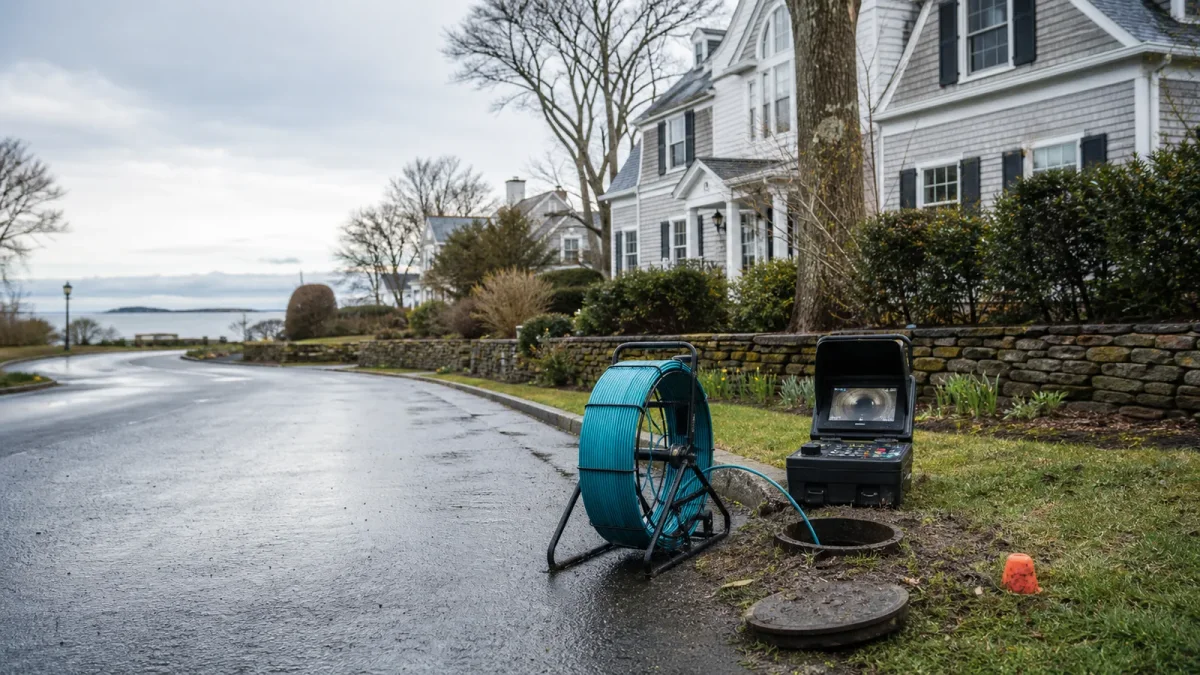
Landscaped Greenwich lots can put a private sewer lateral beneath stone walks, mature planting beds, driveway paving, and walls. Protecting those features starts with finding the pipe, rather than choosing a repair from a photograph of the yard. Fairfield Premier Trenchless uses the recorded condition and access constraints to frame sewer line repair or replacement, including where trenchless work can reduce surface disturbance and where excavation remains necessary.
Greenwich also calls for care with assumptions. A property near the shoreline and a house farther inland may have very different routes, connections, and places to stage equipment. Neither a neighborhood name nor the appearance of a home establishes the material underground. Start with the private pipe serving the address, then build a plan around the evidence.
Trenchless Sewer Repair for Greenwich Homes
Landscaped routes need a surface protection plan
A lateral crossing an ornamental garden raises different access questions from a line beneath an open lawn. Mark the surveyed route on a property sketch and show the cleanout, building exit, approximate depth observations, and connection endpoint. Add irrigation, lighting, specimen trees, and hardscape that the owner wants protected. These features affect equipment movement even when no continuous trench is proposed.
The planning conversation around Greenwich Avenue can involve compact building frontage, pedestrian access, and little room for staging. Along residential streets near Putnam Avenue, a driveway crossing or a connection toward the road may become the controlling feature. Those are reasons to inspect the individual route, not claims that every property on either corridor has the same sewer arrangement.
Older houses with additions deserve particular attention at the building exit. A renovated kitchen or expanded living area does not prove that buried piping was renewed. Ask for prior permits, inspection recordings, or repair sketches, then compare those records with the current survey. A material transition can reveal a past partial repair that changes the proposed treatment length.
Separate coastal concerns from inland access questions
In Old Greenwich, Riverside, and other shoreline settings, ask whether drainage symptoms track rainfall or occur during ordinary household use. Wet weather can expose more than one problem at once. A sanitary lateral investigation should remain separate from a roof leader, footing drain, or storm drain pipe repair assessment until the actual connections are documented.
Farther inland, including properties approached from Round Hill Road or Lake Avenue, long drives, slopes, walls, and established trees can influence equipment access. A larger lot does not automatically provide a suitable launch pit or a direct pull path. The crew needs an approach that respects the actual driveway geometry and places equipment within practical reach of the work.
Do not infer groundwater levels, buried ledge, or pipe depth from these neighborhood descriptions. Those conditions need site evidence. If excavation becomes necessary, the proposal should explain how uncertain ground conditions will be handled and which findings would trigger a revised scope.
Greenwich Permits and Requirements for Sewer Work
Establish the connection and the responsible boundary
Before scheduling, confirm whether the affected line reaches a public sewer or a private septic system. For a septic-connected building sewer, a clear pipe does not demonstrate that the tank or disposal area functions properly. For a public connection, distinguish the private segment from any work involving the municipal main or right of way.
Ask the appropriate town office to confirm current permit, inspection, contractor qualification, and restoration requirements for the particular scope. Work near a sidewalk or street may involve different coordination from work confined to a yard. Record who obtains approvals, arranges inspection access, and closes the permit, rather than leaving those tasks implicit in the proposal.
Boundary questions also matter where a route approaches a neighbor’s land or a shared drive. The scope should identify any required access agreement before equipment arrives. A camera distance alone does not establish ownership, an easement, or permission to excavate across a boundary.
What Makes Trenchless Sewer Repair Different in Greenwich
Build a defect map that can be checked above ground
A sewer camera inspection should record the starting point, direction, material, diameter, fittings, and defect distances. Locate important stations at the surface where feasible. That allows the owner to see whether a root entry point lies under a driveway edge, an accessible bed, or a retaining structure before comparing methods.
Deposits and roots can hide the wall. If cleaning is needed, document what can safely be removed and inspect again afterward. An impassable section should be identified as an inspection limit, with the unseen length carried as an uncertainty. Do not turn a partial recording into a claim that the entire lateral is suitable for rehabilitation.
Standing water needs its own explanation. The camera can show water without proving the exact elevation profile or cause. Ask whether additional locating or measurements are needed to distinguish a grade issue from a temporary obstruction. That distinction matters because a liner follows the existing alignment.
Choose a method around the host pipe and work zone
CIPP pipe lining may suit a cleanable host with usable geometry and documented joint leaks, root entry points, or deterioration. The Greenwich proposal should show where the liner begins and ends, how branches are handled, and what existing access can support installation. Surface protection still includes hoses, equipment placement, and the route through the property.
Pipe bursting can be evaluated when replacement is appropriate and a workable pull path exists. It normally requires launch and receiving access. Bends, nearby utilities, material transitions, and the position of walls can constrain that path. Replacing a damaged line does not justify assuming that every landscape feature can remain untouched.
An isolated defect may instead support a sectional repair or a small excavation. Compare that bounded scope with full rehabilitation when the rest of the route is documented as sound. Conversely, several root entry points or widespread deterioration can make one patch an incomplete answer.
Trenchless Sewer Services We Offer in Greenwich
Compare complete scopes before approving the work
| Recorded finding | Question for the proposal |
|---|---|
| Roots at a documented joint | Is cleaning sufficient, or does the entry point need repair? |
| Serviceable alignment with multiple leaking joints | Can a designed liner cover the affected run? |
| Broken section blocking inspection | What access is needed to expose it and survey beyond it? |
| Suspected low section | What evidence supports the grade correction plan? |
| Pipe beneath a stone walk | Where will access and restoration actually occur? |
The written scope should include preparation, treated length, connection work, service interruption, property protection, permits, and closing evidence. Keep restoration explicit: replacing soil is different from restoring a planting bed, resetting stone, or repairing irrigation. Discuss who handles each affected feature and how completion will be documented.
Prepare the property record and nearby context
Send the street, symptoms, system type if known, available footage, and access concerns when requesting a review. Note whether backups follow rainfall, affect several fixtures, or return soon after cleaning. Keep the original and closing videos together with the final scope, material records, and inspection documents so a future owner can understand the work.
Nearby planning guides include Stamford, Darien, New Canaan, and Westport. They provide useful comparisons for access and system questions, while the Greenwich address still determines the actual repair plan. Send the property details to begin with the route and recorded condition.
Urgent and specialized sewer work in Greenwich
When a line fails without warning, review emergency sewer repair in Greenwich and sewer backup repair across Fairfield County, since a single-home backup and a shared-main problem call for different responses. Recurring slowdowns often trace back to tree root removal in Greenwich sewer lines, confirmed on camera before any repair is chosen.
Older Greenwich laterals may involve Orangeburg pipe replacement in Fairfield County or epoxy pipe lining, while a buried water service is a separate scope handled through trenchless water line replacement in Greenwich. For a defect beneath a finished floor, under-slab sewer repair in Fairfield County is located before the slab is opened.
Decision check
Confirm the property system before scoping the line
01Is the property on public sewer, a limited district, or septic?
02Which part of the private piping is involved?
03What access, groundwater, surface, or ledge constraints apply?
04Which municipal records or permits should be checked?
Questions
Frequently asked
01Can a Greenwich lateral be repaired beneath established landscaping?
Possibly. A camera survey and surface locating should establish whether lining can use existing access or replacement requires pits near planting beds, pavement, or walls.
02Does a Greenwich address establish public sewer service?
No. Confirm the actual connection and responsibility for the affected segment before treating it as a public-sewer lateral or septic-connected building sewer.
03Can lining correct a low section of pipe?
Lining follows the existing route. Standing water requires further evaluation, and a proposal should explain whether excavation is needed to correct grade.