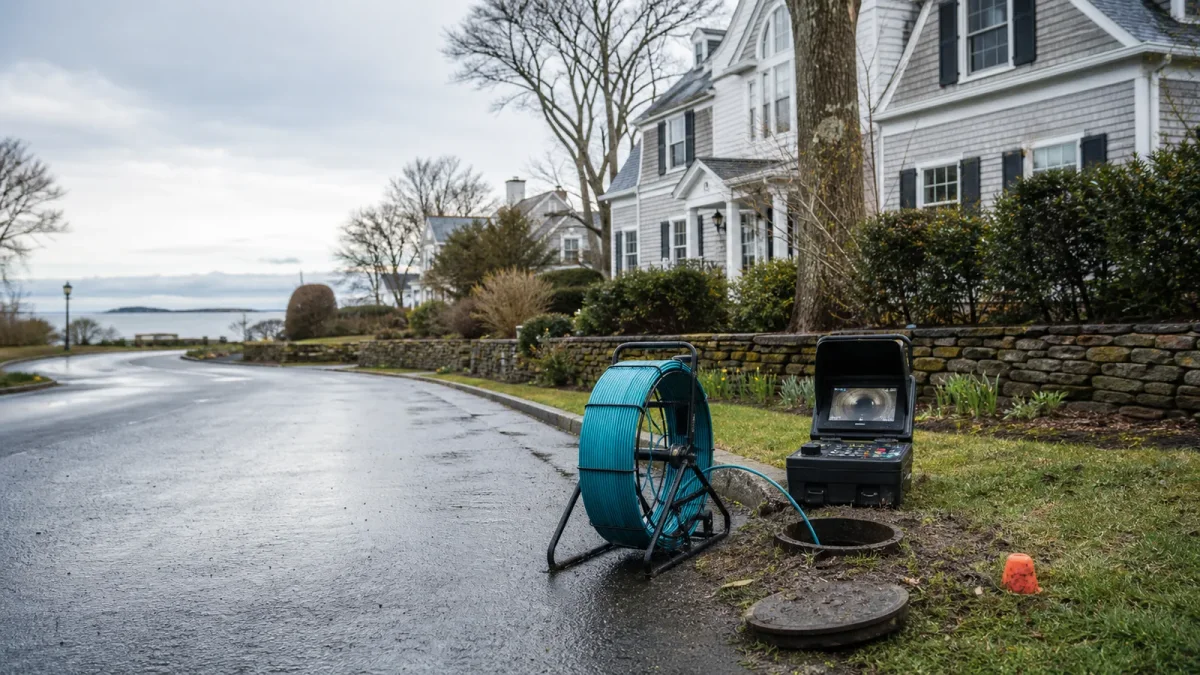
Fairfield Premier Trenchless includes Stamford in the Fairfield service ring, but distance does not establish sewer availability or responsibility. Stamford is the largest city in the county by population, and that scale means the private-lateral questions that apply elsewhere in Fairfield County show up here across more streets, more lot configurations, and more decades of construction history. The first task, as with any address in the service area, is to identify the serving system and the private pipe involved before any repair method gets discussed.
Trenchless Sewer Repair for Stamford Homes
Verify the property system before selecting a method
Largest Fairfield County city with dense older housing, glacial soils, and private laterals that often sit under driveways and landscaped yards. In practical terms, this is a mix of pre-war downtown and South End housing stock, mid-century North Stamford development, and newer construction, all tied into a citywide collection system where the private lateral remains the homeowner’s responsibility regardless of block or era.
Determine whether the observed symptom sits inside the private lateral or relates to the public collection system before assigning a repair method. A backup that affects only one property points toward the private line; a backup that several neighbors report around the same time points toward the public main or a downstream blockage that is not the homeowner’s to fix.
Stamford’s glacial soils and shallow ledge in parts of the city change what a contractor can assume about dig conditions. A lateral that looks straightforward on paper can still require rock-aware excavation planning if a pit becomes necessary, which is one more reason to confirm pipe material and depth with camera and locating evidence rather than guessing from house age alone.
Many Stamford laterals run under driveways, retaining walls, or mature landscaping rather than open side yards, since lots in North Stamford and other established neighborhoods were often developed before utility placement anticipated later repair access. A route-specific survey should record exactly where the line passes beneath these features before a method is proposed.
A Stamford backup investigation should record whether nearby properties report the same event, since combined infrastructure age and city-scale density make it easy to mistake a shared public-system issue for an isolated private failure. Noting the timing and distribution of complaints keeps the diagnosis honest.
A private repair proposal should identify the property-side segment rather than imply control of city sewer infrastructure. The scope of work, and the invoice, should describe only what sits on the owner’s side of the connection unless the city has separately authorized work on its own main.
Street, sidewalk, or driveway access in a Stamford neighborhood may add traffic-control, permit, and restoration requirements to what would otherwise be a short repair. Dense blocks with limited curb space can make staging as much a planning question as the pipe condition itself.
The closing record should preserve lateral footage separately from any observations about the municipal connection, so that a future owner, inspector, or appraiser can tell at a glance what was documented on the private side of the line.
Stamford Permits and Requirements for Sewer Work
Start with the agency that controls the connection or onsite system
Stamford’s size means sewer and building permit questions typically route through the city’s engineering and health department channels rather than a single small-town office. Confirm the current permit form, inspection notice period, contractor licensing requirement, and any street-opening or right-of-way permit that applies to the specific block before scheduling work.
Permit requirements can change, and a city of Stamford’s scale often has more than one department involved depending on whether work touches the curb, the sidewalk, or only the private yard. Confirm the current form, inspection notice, contractor qualification, and restoration obligations before work begins rather than relying on what a neighboring property needed last year.
What Makes Trenchless Sewer Repair Different in Stamford
Access and pipe evidence must be evaluated together
Tight downtown lots, glacial soils, buried ledge, mature North Stamford landscaping, and dense street parking can all govern access and timing in ways that a generic repair estimate will not capture.
A measured sewer camera inspection should identify material, diameter, transitions, access, defect stations, and the point where the survey stops. If deposits hide the pipe wall, drain cleaning or hydro jetting may be needed before a repair decision can be made with confidence.
Public-sewer laterals and septic-connected building sewers are not interchangeable, and Stamford includes both depending on the exact address. The responsible agency, inspection boundary, repair method, and records differ by system, so confirming which one applies is not optional paperwork, it is the first branch point in the whole decision.
Comparing CIPP lining and pipe bursting for a Stamford lateral
CIPP pipe lining is usually the first option evaluated once a camera survey shows a pipe with usable geometry, meaning the existing line is not collapsed or significantly out of round. A resin-saturated liner is pulled or inverted through the existing pipe and cured in place, which can address leaking joints, root intrusion points, and internal corrosion without a trench along the route. For a driveway or landscaped yard in North Stamford or elsewhere in the city, this is often the method that limits restoration scope the most.
Pipe bursting is the planning path when the camera survey shows a collapsed section, significant deformation, or a line that is undersized for current fixture loads. Bursting draws a new pipe through the old one while fracturing the original material outward, but it still typically requires entry and exit pits. On a lot where the lateral runs under a driveway slab or a retaining wall, those pit locations become a real part of the proposal, not an afterthought, and should be discussed before a contract is signed.
Both methods depend on an accurate route survey first. Stamford’s mix of lot ages and soil conditions means the same symptom can point to different methods on two different streets, which is exactly why a remote diagnosis without camera evidence is not a sound basis for choosing between lining and bursting.
Trenchless Sewer Services We Offer in Stamford
Compare methods only after the defect map is complete
| Finding | Possible planning path |
|---|---|
| Roots or deposits in a serviceable pipe | Cleaning, then a closing inspection |
| Leaking joints or internal corrosion with usable geometry | CIPP pipe lining evaluation |
| Collapse or deformation along a replaceable route | Pipe bursting evaluation |
| One isolated accessible defect | Targeted spot repair |
| Standing water or suspected grade problem | Further locating and replacement planning |
| Uncertain condition during a purchase | Pre-purchase sewer inspection |
These are planning paths rather than remote diagnoses. The recorded condition, not the neighborhood or house age alone, decides which options remain viable for sewer line repair or replacement on a given Stamford property.
Information to include with a request
- The Stamford street or neighborhood, including whether the lot is in a denser downtown block or a more spread-out North Stamford setting
- Public sewer or septic, if known
- Property type and approximate building age
- Symptoms, frequency, and fixtures affected
- Camera footage, written findings, or a competing proposal
- Access concerns such as finished interiors, driveways, retaining walls, trees, slopes, or shallow ledge
Records to keep after the work
Retain the pre-work and post-work camera videos, written defect locations, cleaning and repair scope, material information, permits or inspections, and restoration responsibilities. These records make future maintenance and property transactions easier, particularly in a city where a lateral may have been partially repaired by a prior owner without full documentation.
Nearby coverage
Stamford sits along the same Fairfield County corridor as Darien, Norwalk, New Canaan, and Fairfield, each with its own mix of soil, housing age, and permit agency worth comparing before assuming one town’s sewer context applies to another.
Send the property context for review, or compare all Fairfield County coverage notes.
West of Stamford, the Greenwich planning guide examines landscaped lateral routes and access around stone walks, walls, and long residential drives.
Urgent and specialized sewer work in Stamford
When a line fails without warning, review emergency sewer repair in Stamford and sewer backup repair across Fairfield County, since a single-home backup and a shared-main problem call for different responses. Recurring slowdowns often trace back to tree root removal in Stamford sewer lines, confirmed on camera before any repair is chosen.
Older Stamford laterals may involve Orangeburg pipe replacement in Fairfield County or epoxy pipe lining, while a buried water service is a separate scope handled through trenchless water line replacement in Stamford. For a defect beneath a finished floor, under-slab sewer repair in Fairfield County is located before the slab is opened.
Decision check
Confirm the property system before scoping the line
01Is the property on public sewer, a limited district, or septic?
02Which part of the private piping is involved?
03What access, groundwater, surface, or ledge constraints apply?
04Which municipal records or permits should be checked?
Questions
Frequently asked
01Is every Stamford property connected to public sewer?
Connection and responsibility still need to be confirmed by address, even where public sewer service is common across the city.
02Why does Stamford soil matter for trenchless planning?
Glacial till and buried ledge can change pit sizing, bursting feasibility, and excavation timelines even when the pipe defect itself is modest.
03What should be checked before sewer work in Stamford?
Confirm the system type, private pipe route, material, access, defect locations, and any municipal permit or inspection requirements.
04Can trenchless work avoid all excavation in a landscaped Stamford yard?
Not always. Lining uses existing access where possible, while bursting normally needs entry and exit pits. The property and recorded pipe condition determine the work zone.
05Does a driveway over the lateral rule out trenchless methods?
No, but it changes the plan. Camera and locating evidence should confirm the exact route before deciding whether lining, bursting, or a pit under the slab is appropriate.