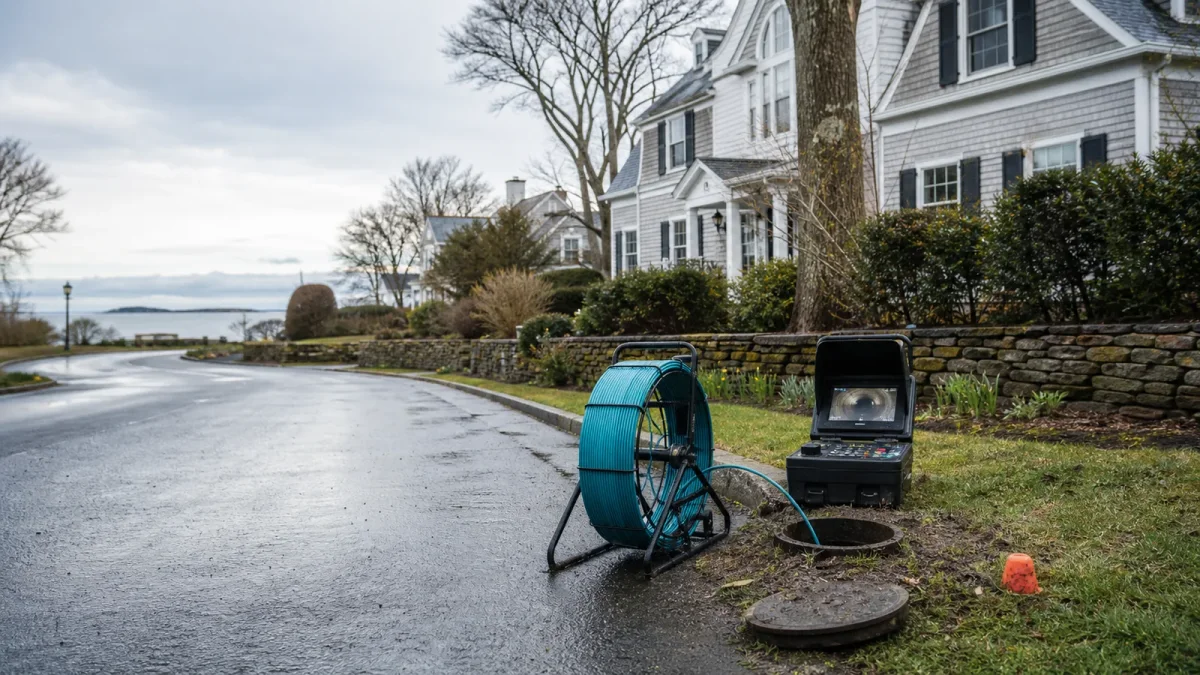
Fairfield Premier Trenchless includes Derby in the Fairfield service ring, but distance does not establish sewer availability or responsibility. The first task is to identify the serving system and the private pipe involved.
Trenchless Sewer Repair for Derby Homes
Verify the property system before selecting a method
Connecticut’s smallest city, with nineteenth-century Naugatuck Valley mill housing on a dense and hilly street grid. In practical terms, this is a compact historic city served by a municipal WPCA collection system, not a generic sewer market.
Confirm the lateral route, connection point, permit category, and property-side responsibility before estimating access.
A Derby scope should use the same repair category shown on the WPCA application.
Steep streets make pipe depth and equipment placement more important than map distance alone.
Older buildings may have interior traps or material transitions that stop a camera before the municipal connection.
A narrow public-facing work zone may require traffic and pedestrian controls in the price.
Closing documentation should identify the repaired station within the private lateral, not the citywide sewer network.
Derby Permits and Requirements for Sewer Work
Start with the agency that controls the connection or onsite system
Derby Water Pollution Control Authority is a primary planning source. Derby reports more than 40 miles of sewer in its municipal system and publishes connection and repair material.
Derby WPCA permit application provides a second independent record. The Derby application distinguishes new sewer connections, sewer repairs, and disconnections.
Permit requirements can change, so confirm the current form, inspection notice, contractor qualification, and restoration obligations before work begins.
What Makes Trenchless Sewer Repair Different in Derby
Access and pipe evidence must be evaluated together
Hills, older structures, narrow work zones, and aging materials can add traffic control and restoration to the repair.
A measured sewer camera inspection should identify material, diameter, transitions, access, defect stations, and the point where the survey stops. If deposits hide the wall, drain cleaning or hydro jetting may be needed before a repair decision.
Public-sewer laterals and septic-connected building sewers are not interchangeable. The responsible agency, inspection boundary, repair method, and records differ by system.
Trenchless Sewer Services We Offer in Derby
Compare methods only after the defect map is complete
| Finding | Possible planning path |
|---|---|
| Roots or deposits in a serviceable pipe | Cleaning, then a closing inspection |
| Leaking joints or internal corrosion with usable geometry | CIPP pipe lining evaluation |
| Collapse or deformation along a replaceable route | Pipe bursting evaluation |
| One isolated accessible defect | Targeted spot repair |
| Standing water or suspected grade problem | Further locating and replacement planning |
| Uncertain condition during a purchase | Pre-purchase sewer inspection |
These are planning paths rather than remote diagnoses. The recorded condition decides which options remain viable.
Information to include with a request
- The Derby street or neighborhood
- Public sewer or septic, if known
- Property type and approximate building age
- Symptoms, frequency, and fixtures affected
- Camera footage, written findings, or a competing proposal
- Access concerns such as finished interiors, drives, walls, trees, slopes, or groundwater
Records to keep after the work
Retain the pre-work and post-work camera videos, written defect locations, cleaning and repair scope, material information, permits or inspections, and restoration responsibilities. These records make future maintenance and property transactions easier.
Send the property context for review, or compare all Fairfield County coverage notes.
Decision check
Confirm the property system before scoping the line
01Is the property on public sewer, a limited district, or septic?
02Which part of the private piping is involved?
03What access, groundwater, surface, or ledge constraints apply?
04Which municipal records or permits should be checked?
Questions
Frequently asked
01Is every Derby property connected to public sewer?
Connection and responsibility still need to be confirmed by address, even where public sewer service is common.
02What should be checked before sewer work in Derby?
Confirm the system type, private pipe route, material, access, defect locations, and any municipal permit or inspection requirements.
03Can trenchless work avoid all excavation?
Not always. Lining uses existing access where possible, while bursting normally needs pits. The property and recorded pipe condition determine the work zone.